DK
DKSustainability
Indoor climate consulting


Sustainability
We offer professional indoor climate consulting to help you ensure optimal conditions for your tenants. A healthy indoor climate is essential for well-being, health, and productivity, and thus also for the property’s overall value.
When you work purposefully to improve the indoor climate in your property, you’re not just creating better conditions for those who spend time in the building. You’re also investing in the property’s operations and future. A healthy indoor climate has the potential to increase energy efficiency and employee productivity, thereby meeting the growing demands of both tenants and ESG reporting.
In other words: An improved indoor climate is not just a matter of comfort, but a long-term, quantifiable, value-creating way to future-proof your property.
In my view, the best advice we can give to property owners is the kind that focuses on the users. The best results are achieved by creating synergies between data and people.
– Kasper Furu
Lead Specialist, Indoor Climate
Sustainability, DEAS


CONTACT US
Contact our Director, Cahtrine Bjørn Hartung, for more information, with no obligation.
Contact Cathrine Bjørn HartungResponsible renovations of new and older buildings
Take a tour of our interactive Sustainability building, which showcases our services in the areas of responsible, energy-efficient, and sustainable solutions.
Take a tour
Sorry, no pages was found
In commercial properties, a good indoor climate is essential for ensuring tenant and employee satisfaction, and can also support a company’s sustainability goals through energy-efficient ventilation and heating.
DEAS specialists can, among other things, provide consulting services regarding indoor climate agreements for commercial properties, assessment and improvement of ventilation solutions, construction consulting, and technical supervision. With our in-depth expertise and experience in indoor climate conditions, combined with the data we obtain from measurements and tests of the indoor climate in your properties, you are guaranteed the highest quality consulting.
At the same time, professional indoor climate consulting can help optimize energy consumption and ensure compliance with legislation and occupational health and safety requirements.
When we provide consulting services on indoor air quality, we naturally base our recommendations on the specific conditions that are key to the indoor environment in your property. This may involve seeking advice regarding the design of new rental units or needing to optimize the indoor climate for an existing property. Regardless, there will be specific factors that influence the indoor climate. These include the building envelope, interior design, and the placement of systems.
These elements directly influence how temperature, air quality, daylight, and acoustics are experienced in daily life, which is yet another important aspect when discussing indoor climate: how it is actually perceived.
With the right indoor climate consulting, you’ll gain an overview of both challenges and opportunities for improvement, as well as a plan for how to create a healthy and comfortable indoor climate that matches the property’s use and technical specifications.
Through indoor air quality testing, we can identify issues such as poor air quality, excessive humidity, mold, or inadequate ventilation. In collaboration with our partners, we ensure that you receive advice on your property’s indoor air quality based on concrete data, which serves as the foundation for targeted improvements.
An indoor climate assessment and subsequent consultation are effective tools for ensuring a healthy indoor climate and a more energy-efficient property. Our indoor climate consultants use a range of simulation tools to perform calculations and predict indoor climate scenarios. Based on the indoor climate tests, we can provide the best possible advice, taking the property’s specific conditions into account. In this way, our indoor climate tests lead to high-quality advice, ensuring you make the best possible investment in your property’s indoor climate.
DGNB auditors oversee the process
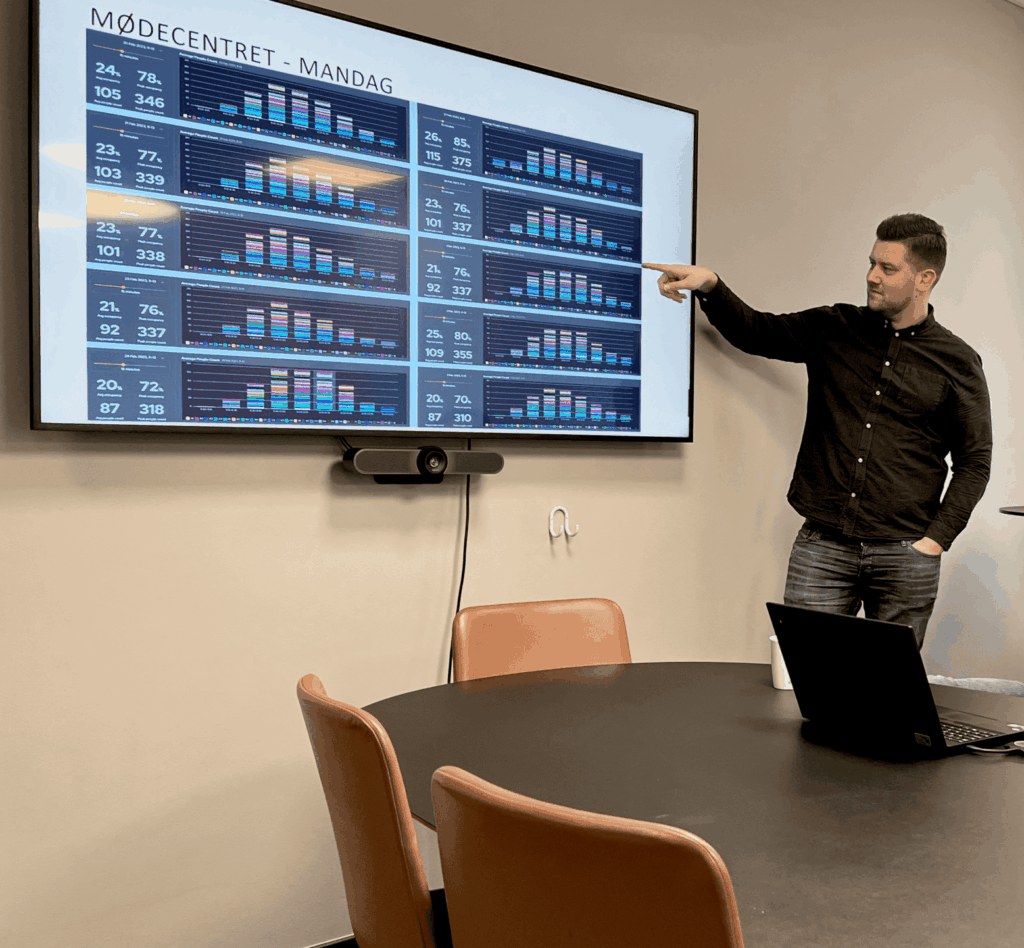
It is essential to have optimal conditions to ensure a comfortable and, above all, healthy indoor climate. This is where our indoor climate consultants come in, ensuring that you receive professional advice on indoor climate and all the factors, criteria, and regulations that are important to consider and document.
Our indoor climate consulting is, of course, based on extensive experience and expertise in the field, but different properties have different conditions. That is why we conduct indoor climate tests and use the data as the basis for each assessment, so we can improve existing conditions.
When we provide consulting services on indoor air quality, the process begins with a thorough technical inspection of the building. The purpose is to assess the building’s physical conditions that affect indoor air quality, including insulation levels, airtightness, ventilation type, choice of materials, and the condition and location of the systems.
We combine this review with specific measurements of parameters such as temperature, relative humidity, CO₂ levels, air exchange rates, and the presence of particles or VOCs. This way, we gain not only a visual and technical overview but also a data-driven understanding of where the challenges lie.
To improve the indoor climate in an existing building and ensure a lasting effect, it is crucial to identify which factors require adjustment, such as insufficient ventilation, thermal bridges, moisture problems, or uneven heating control. The diagnosis forms the basis for targeted recommendations that take into account the building’s function, usage patterns, and technical capacity.
To assess and improve the indoor climate in both new and existing buildings, our indoor climate experts use advanced simulation tools. These tools make it possible to analyze, predict, and visualize how various factors, such as ventilation, materials, daylight, and heat load, affect the indoor climate. At the same time, they allow us to model how changes to these conditions will play out in practice.
An indoor climate simulator serves as a decision-making tool that enables the design or adaptation of buildings to provide greater comfort, lower energy consumption, and fewer indoor climate-related issues before challenges even arise.
The simulations complement physical measurements and create a solid data foundation for making informed decisions. This is particularly valuable in projects where indoor climate and energy consumption must be documented. This may, for example, be in connection with ESG reporting or DGNB certification, where both social factors such as comfort and environmental factors such as energy efficiency are key assessment criteria.
At DEAS, we also provide consulting services on ESG reporting and DGNB certification. Read more here.
DGNB certification of new construction and major renovations
Users’ experience of the space is a crucial factor in assessing the indoor climate. It’s not just about measurement data, but also about how temperature, air quality, noise levels, and lighting conditions actually feel in everyday life. That’s why we combine technical analyses with the experiences of those who use the building on a daily basis.
We advise on how indoor climate measures can be implemented in a way that is practical, energy-efficient, and tailored to the building’s function. This may include solutions for ventilation, humidity control, solar shading, or intelligent control systems. The goal is always to achieve a demonstrable improvement in comfort while ensuring that operations remain economically and technically sound.
Indoor climate consulting isn’t just about solving specific problems in the here and now. It is also about thinking strategically and for the long term. At DEAS, we work with holistic solutions that both improve comfort for those who spend their days in the building and enhance the property’s value and operational efficiency. This can range from optimizing ventilation, humidity control, and temperature regulation to selecting materials, daylighting strategies, and energy management.
The goal is to create healthy, effective, and verifiable indoor climate solutions that are tailored to the property’s use, technical capabilities, and financial constraints.
When you choose DEAS to consult on sustainability and indoor climate, you gain access to reliable expertise, not only before and during the process of improving indoor air quality, but also afterward. We consider it essential to recommend solutions that work in practice. That is why we follow up and evaluate the effectiveness of the measures, ensuring you achieve lasting and verifiable results.
We are also available throughout the entire process should you need technical support regarding changes and initiatives. With many years of experience and extensive knowledge of indoor climate, we consider it our most important mission to ensure responsible efforts to improve indoor climate conditions so that they are as optimal as possible and, above all, sustainable.
A key factor in a healthy indoor environment is a properly functioning ventilation system. When we provide consulting services for a project involving an older property or a building that needs to be renovated or have its indoor environment optimized, we assess the existing ventilation systems. By assessing the efficiency of the ventilation based on the building’s use and air quality, the identified weaknesses can be turned into potential opportunities for optimization, modifications, or replacement.
A healthy indoor climate requires air movement and exchange. Inadequate ventilation can lead to the accumulation of CO2, moisture, and particles, which can negatively impact both comfort and health. Therefore, properly sized and reliable ventilation is a central part of any indoor climate assessment—and often an obvious place to start when the indoor climate needs to be significantly improved.
At DEAS, we are committed to providing the highest quality consulting services, which is why we always stay up to date in our field. We continuously monitor developments in new technologies and methods for improving indoor environments.
This allows us to compare traditional solutions with newer, more intelligent approaches. For example, through the use of real-time data, automated systems, or hybrid ventilation methods. We help you choose the best solutions that deliver the greatest impact, both for the building’s occupants and for the property’s overall value.